



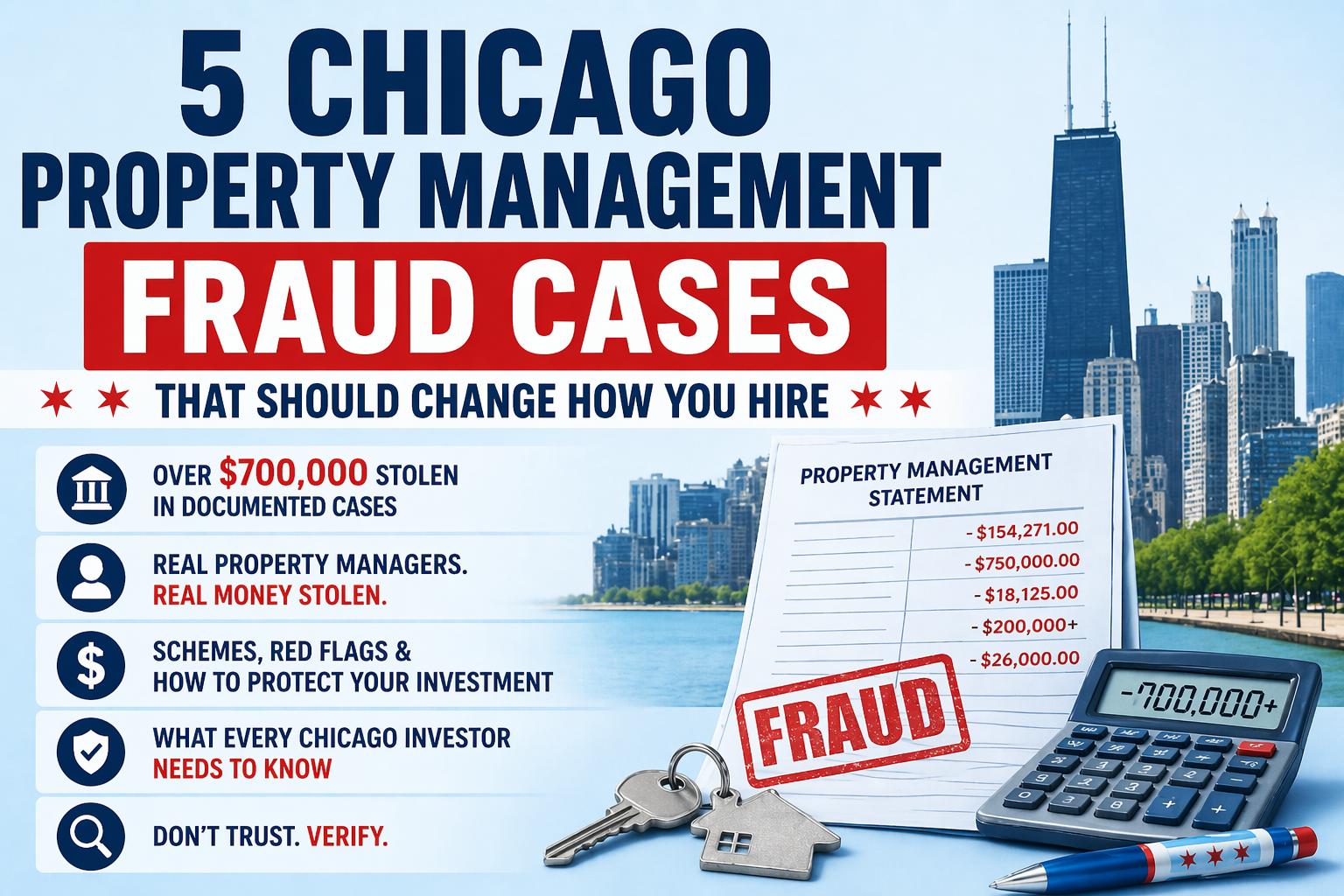
Real cases. Real money stolen. And what Chicago investors can do to protect themselves.
Most Chicago real estate investors spend a lot of time thinking about market conditions, interest rates, rent growth, and renovation costs. They spend far less time thinking about the person or company they hand their property over to once the deal closes. That gap is a real problem.
Across Chicago and its suburbs, in courtrooms and in federal indictments, there is a long and well-documented record of property managers who did not just underperform. They stole. And in many cases, they stole for years before anyone caught on.
This isn’t a scare piece. It’s a factual look at documented cases from Chicagoland, a breakdown of how these schemes work, and a practical guide for investors to protect themselves. Anyone who owns rental property in the Chicago market (or plans to) should read this before signing a management agreement.
Key Takeaways for Chicago Real Estate Investors
The Alan P. Gold case in Edgewater shows how a trusted, licensed property manager can skim reserve funds for four years using falsified monthly statements ($154,271 confirmed; $750,000 more suspected).
Property manager fraud rarely requires sophistication. Rerouting rent payments, forging invoices, and skimming money orders are the common mechanisms.
The HAM Management / Ilyas Lakada case shows that fraud schemes can target public programs (over $700,000 in rental assistance applications with $200,000+ obtained) in addition to individual owners.
Credentials, community standing, and a license do NOT guarantee trustworthiness. Every case in this analysis involved a licensed or credentialed operator.
Separate trust accounting, direct bank statement access, vendor transparency, and NARPM affiliation are the baseline controls every Chicago investor should verify before hiring.
The property management industry is largely unregulated at the operational level in Illinois. Owners are the last line of defense on their own money.
Five Documented Chicagoland Fraud Cases at a Glance
Each of these cases involves a licensed or credentialed property management professional operating in the Chicago metro. The scheme type, scale, and legal outcome vary, but the pattern (weak controls + signature authority + trusting clients) is consistent.
Defendant / Firm | Scheme | Known Loss | Outcome |
Alan P. Gold / A.P. Gold Realty | Overbilling, reserve skimming, falsified statements | $154,271 (Edgewater) + $750K suspected | Federal mail fraud charges |
Cassandra Evans / Eastlake Mgmt | Rent payments rerouted to personal account | Not specified | Charged with theft + wire fraud |
Delvya Harris / Habitat Company | Money orders stolen; separate PPP fraud | $18,125 + $41,000 PPP | 2-year prison sentence |
HAM Management / Ilyas Lakada | Fabricated tenants, forged leases, fake utility bills | $200K+ obtained on $700K+ claimed | City of Chicago lawsuit, triple damages sought |
Naperville case | HOA embezzlement by civic leader / real estate agent | ~$26,000 | Charges filed |
Each case below is drawn from publicly available sources: U.S. Department of Justice press releases, Illinois Attorney General filings, Cook County Circuit Court records, and Chicago Sun-Times reporting.
Case 1: Alan P. Gold / A.P. Gold Realty (Edgewater) – Nine Associations Victimized
This is the case that should be required reading for every condo association board member in Chicago. Alan P. Gold was the owner and operator of A.P. Gold Realty & Management, a Chicago-based property management company. He wasn’t some obscure operator. He was a licensed professional with signature authority over client bank accounts, which is exactly how he was able to run the scheme for years.
According to a federal criminal complaint filed in U.S. District Court in Chicago and announced by the U.S. Attorney’s Office for the Northern District of Illinois, Gold overbilled the Edgewater condominium association by withdrawing multiple management fee checks in the same month and tapped into the association’s reserve fund to write himself substantially larger checks to which he was not entitled. He then covered his tracks by sending the association fraudulent monthly statements showing account balances higher than what actually existed. The association had no idea.
The Edgewater association alone lost $154,271 between 2010 and 2014. Four years of undetected theft. And that association was just the one named in the initial complaint. Investigators suspected Gold had stolen an additional $750,000 from eight other Chicago condominium associations he managed. He was charged with mail fraud, which carries a maximum sentence of 20 years in federal prison.
The Takeaway from the Gold Case
Reserve funds are a prime target. Falsified financial statements are the primary tool. And this kind of theft can go on for years if no one is independently verifying the actual bank records against the reports being delivered to the board.
Case 2: Cassandra Evans / Eastlake Management (Princeton Park) – Rent Diversion
Cassandra Evans worked as a property manager for Eastlake Management, the company responsible for managing Lowden Homes, a Chicago Housing Authority property on the Far South Side. Her job included collecting rent from tenants and depositing those funds into Eastlake’s bank account.
Instead, according to charges filed by the Illinois Attorney General’s office, she added her own name as a payee without authorization and deposited tenant rent payments directly into her personal bank account.
Evans was charged with theft of government money, theft, and wire fraud, all felonies. While the dollar amount was smaller than the Gold case, the mechanism is worth understanding. She didn’t hack anything. She didn’t forge elaborate documents. She simply changed where the money went and counted on the fact that oversight was loose enough that nobody would notice quickly. In a well-run management operation, that kind of transaction anomaly gets caught immediately.
The Takeaway from the Evans Case
Theft does not require sophistication. It requires opportunity and weak internal controls. The more visibility and verification a property owner builds into the payment process, the harder this kind of fraud becomes.
Case 3: Delvya Harris / Habitat Company (South Deering) – Money Orders Stolen
Delvya Harris was an assistant community manager for the Habitat Company at the CHA’s Trumbull Park Homes in South Deering. Between December 2022 and March 2023, she stole 50 money orders totaling $18,125 from tenants and deposited them into her personal bank account. In some cases she handed checks to her significant other to cash. She was also convicted of filing fraudulent PPP loan applications for businesses that did not exist, collecting more than $41,000 in pandemic relief funds she wasn’t entitled to.
Harris was sentenced to two years in prison. The CHA worked with Habitat to make sure tenants were credited for their payments after the theft was discovered. But the tenants who paid in good faith had no way of knowing their money was being stolen. They trusted the system.
The Takeaway from the Harris Case
Tenants and owners alike are exposed when a property manager has unchecked access to payment collection. Transparent payment processing and tenant-facing confirmation systems aren’t optional extras. They’re the minimum control structure needed to catch this kind of fraud quickly.
Case 4: HAM Management / Ilyas Lakada (Chicago) – Rental Assistance Fraud
In September 2024, the City of Chicago filed a sweeping lawsuit in Cook County Circuit Court against HAM Management LLC and landlord Ilyas Lakada, an Illinois-licensed attorney who had previously worked for the Chicago Department of Aviation. The allegations were extensive: fabricated tenants, forged lease documents, fake utility bills, fraudulent rental ledgers, and applications for rental assistance funds on properties the defendants did not even manage.
In one example, Lakada claimed $36,000 in unpaid rent for a property at 6140 N. Kimball Avenue, representing himself as both landlord and tenant. Investigators found he did not acquire the deed to the property until months after the period of alleged unpaid rent he claimed. HAM Management was formed just one month after the City announced its Emergency Rental Assistance Program, which signals something about the intent from the start.
Together the defendants applied for more than $700,000 in rental assistance funds and obtained over $200,000 through the fraud. The City is seeking triple damages in addition to repayment.
The Takeaway from the HAM Case
Fraud isn’t always a manager stealing from the owner. Sometimes the owner and manager are both parties to a scheme that ultimately harms tenants, public programs, and the credibility of the rental housing industry. The red flags here (a brand new company formed immediately after a public funding program launched, a principal with both landlord and tenant hats) were visible at the start.
Case 5: Naperville – Civic Leader and Real Estate Agent Charged
This pattern isn’t limited to Chicago city limits. In Naperville, a prominent civic leader and licensed real estate agent was charged with embezzling nearly $26,000 from a homeowners association on the city’s northeast side.
What makes this case instructive is the profile of the accused: not a shadowy operator, but a recognizable community figure with a professional license and a public reputation. That reputation was part of the cover.
The Takeaway from the Naperville Case
Credentials and community standing aren’t the same thing as trustworthiness. Due diligence doesn’t stop at the license check. A property manager’s visibility in the community can actually amplify an investor’s false sense of security, which is exactly what makes these cases hit harder when they surface.
How Property Management Fraud Schemes Actually Work
Across these five cases and dozens more nationally, the mechanisms of property manager fraud follow recognizable patterns. Understanding them is the first line of defense for a Chicago investor.
Overbilling and Phantom Invoices
A manager charges for services never performed, or bills the same service multiple times. Vendors are sometimes real companies, sometimes entirely fabricated. The fraudulent invoices get processed and paid because nobody is independently verifying the work was actually done.
Reserve Fund Skimming
The manager has signature authority over the association reserve account and writes checks to themselves, to shell entities, or to vendors who kick back a portion. This is particularly insidious because reserve funds are touched infrequently, and boards often have limited visibility into them between major capital projects. The Gold case in Edgewater is the textbook example.
Rent Payment Diversion
Collected rent is redirected to a personal account rather than forwarded to the owner. This can go undetected for months if the manager is also responsible for reporting to the owner, since they control what the owner sees. The Evans case is the textbook example.
Vendor Kickbacks
The manager steers maintenance and repair contracts to companies willing to pay them a cut. The owner pays above-market rates for work, and the manager pockets the difference. This is one of the most common and hardest-to-detect forms of property management fraud because the invoices look legitimate on paper.
Falsified Financial Statements
Once a manager is stealing, the financial reports sent to owners or boards need to lie. The Gold case is the textbook example: statements showing account balances higher than reality, sustained for years, while the theft continued undetected. If an owner is relying entirely on monthly reports produced by the same person who controls the money, there’s no meaningful check in the system.
Where to Go Deeper on Chicago Property Manager Due Diligence
Before signing any management agreement in Chicago, an investor should work through multiple layers of due diligence. These verified GC Realty resources pair directly with this analysis:
• When Looking For a Property Manager In Chicago, the One Thing No One Looks At is GC Realty’s step-by-step walk-through of how to verify an Illinois real estate license in under two minutes.
• Best Chicago Property Management Companies 2026 is GC Realty’s insider guide to firms operating in the Chicago market.
• What Chicago Property Manager Has the Best Reviews? walks through how to actually read review volume and consistency, beyond the star rating.
Investors evaluating GC Realty specifically can start with a free rental analysis and verify the company’s credentials and coverage against this article’s checklist.
Red Flags to Watch for When Hiring a Chicago Property Manager
The best time to protect yourself is before signing the management agreement. Here’s what to look for and what to ask.
They Can’t Show a Clear Trust Accounting Structure
Owner funds should be held in a dedicated trust account, entirely separate from the management company’s operating funds. If a manager is vague about how client money gets handled, walk away.
They Resist Giving Direct Access to Bank Statements
A legitimate property manager has nothing to hide. If the only financial reporting an owner receives is a summary the manager produces themselves, with no access to the underlying bank records, that’s a significant control weakness. The Gold case relied entirely on that setup.
Their Vendor Relationships Are Opaque
Ask whether the management company earns any referral fees or markups from maintenance vendors. A reputable Chicago firm will answer this question clearly. One that is evasive or dismissive of the question is worth scrutinizing further.
They’re Not NARPM Members or Can’t Demonstrate Professional Affiliations
The National Association of Residential Property Managers (NARPM) holds members to a code of ethics and professional standards. It’s not a guarantee of integrity, but it’s a baseline signal of professionalism and accountability.
The License Hasn’t Been Verified
Every property manager operating in Illinois is required to hold an active real estate license. Looking one up takes less than two minutes and costs nothing. GC Realty’s step-by-step guide to looking up a property manager’s license walks through exactly how to do it. If a manager’s license is expired, suspended, or doesn’t exist, that conversation ends immediately.
Reviews Are Thin, Recent, or Suspiciously Uniform
Look for a track record of verified reviews across multiple platforms over multiple years. A company with 30 five-star reviews all posted in the same 60-day window is not the same thing as a company with 300 reviews built over a decade of managing real properties.
Fees That Seem Too Good to Be True
A management fee dramatically below market is worth questioning. Professional property management requires real overhead: licensed staff, insurance, accounting systems, maintenance coordination. Somebody charging below-market fees is often being subsidized somewhere else in the relationship, and that somewhere else is usually the owner’s maintenance budget or vendor markups.
What 20-Plus Years in Chicago Real Estate Has Taught the GC Realty Team
Mark Ainley has been in Chicago real estate for over 20 years, renovated and stabilized more than 500 properties across Chicagoland, managed properties directly until 2015, and served on numerous HOA boards over the years, including two he currently sits on. That combination of experience (investor, former manager, and active board member) gives the kind of perspective on these cases that goes beyond reading DOJ press releases.
The single most important thing Chicago investors should internalize: the financial statements a property manager sends are only as trustworthy as the controls behind them. An owner relying entirely on monthly reports produced by the same person who controls the money has no checks and balances. They have faith. And in every case above, faith cost people hundreds of thousands of dollars.
The second thing worth naming clearly: the property management industry is largely unregulated at the operational level in Illinois. Managers need a real estate license, but the day-to-day practices, the accounting systems, the trust account structures, the vendor relationships, these aren’t subject to meaningful routine oversight. The market is self-policing, which means the owner is the last line of defense on their own money.
That’s why who gets hired matters more than most Chicago investors realize when they’re evaluating management companies on price alone.
What a Reputable Chicago Property Management Company Looks Like
GC Realty & Development has built its operation around the kind of transparency and accountability that protects owners from exactly the scenarios described in this article. The firm manages approximately 1,500 units across Cook, DuPage, and Kane counties and has appeared four times on the Inc. 5000 list of fastest-growing private companies. That track record didn’t happen by accident.
Every Chicago property management client deserves these as a baseline:
Separate trust accounting for owner funds, with direct owner access to statements
Full transparency on vendor relationships and any maintenance markups
Active NARPM membership and adherence to professional ethics standards
Owner portal access with real-time financial reporting, not summary-only statements
• Licensed, insured, and accountable staff with clear lines of responsibility
A verifiable track record with real reviews built over years, not weeks
For any Chicago investor currently working with a property manager where any of the red flags in this article resonate, it’s worth having a conversation. Not every management relationship that underperforms involves theft. But every theft case started with an owner who trusted without verifying.
Frequently Asked Questions About Property Manager Fraud
How common is property manager fraud in Chicago?
More common than most investors realize. The five cases in this article are just the ones that became public through federal indictments, state charges, or City of Chicago lawsuits. The cases that settle quietly (or go undetected entirely) never make the news. The pattern across Chicagoland is consistent enough that every investor should treat controls and verification as core due diligence, not optional extras.
Can an owner really be liable when a property manager steals?
Yes, in specific ways. If trust accounting is mishandled, the owner’s funds can be tied up in a bankruptcy or fraud recovery process. If the manager’s scheme involves tenant money (like the Harris case), the owner can face tenant credit disputes and reputational exposure. And if an uninsured worker is injured at the owner’s property by a fraudulent or non-compliant operator, the owner can be named in the resulting claim.
What’s the single fastest due diligence step?
Verify the Illinois real estate license. It takes under two minutes and is free. An expired, suspended, or non-existent license ends the conversation immediately. Every legitimate Chicago property manager holds an active license, and confirming it is the easiest filter available.
Does NARPM membership actually matter?
It’s not a guarantee of integrity, but it’s a baseline signal of professional affiliation and ethical standards. NARPM members adhere to a code of ethics and continuing education requirements. A Chicago property manager who isn’t a NARPM member isn’t automatically a fraud risk, but a firm that can’t point to any professional affiliation at all is worth scrutinizing.
Should an owner demand access to actual bank statements?
Yes. Summary reports produced by the property manager themselves are not a substitute for access to the underlying bank records. This exact gap is how the Gold case at Edgewater went on for four years. A legitimate Chicago firm has nothing to hide and will provide bank-level visibility on request.
What if an owner suspects something is already off?
Act quickly. Pull recent statements, compare them against bank records if accessible, and consult an attorney familiar with Illinois property management law. The faster documentation gets pulled, the stronger any recovery position becomes. Waiting to “watch for a pattern” is exactly what every defrauded owner in this article did, and it cost them years of undetected theft.
Does a Chicago property owner’s landlord insurance cover property manager theft?
Usually not. Standard landlord or rental property insurance covers the owner’s building and certain third-party liability claims tied to the property. Theft by a property manager is typically covered (if at all) by the property management company’s own fidelity bond or crime coverage, which is another reason to ask about the firm’s insurance program before signing.
Trust, But Verify Everything
The common thread across every case in this analysis isn’t sophistication. It’s opportunity: a licensed operator with signature authority, a trusting client, weak oversight, and months or years of uninterrupted access to the money. Breaking that chain is entirely within a Chicago investor’s control, and it starts at the hiring decision.
Investors evaluating Chicago property management firms who want to work with a company whose credentials, trust accounting structure, and vendor relationships can be verified directly can call the GC Realty office at 630-587-7400 or start with a free rental analysis. For ongoing insight into Chicago real estate investing, the Straight Up Chicago Investor Podcast and the Chicago Landlord Secrets Podcast (live every Thursday on YouTube, Instagram, Facebook, and LinkedIn) cover topics like this regularly.
Case details referenced in this article are drawn from publicly available sources including U.S. Department of Justice press releases, Illinois Attorney General filings, Cook County Circuit Court records, and Chicago Sun-Times reporting. This article is for informational purposes only and does not constitute legal advice.