



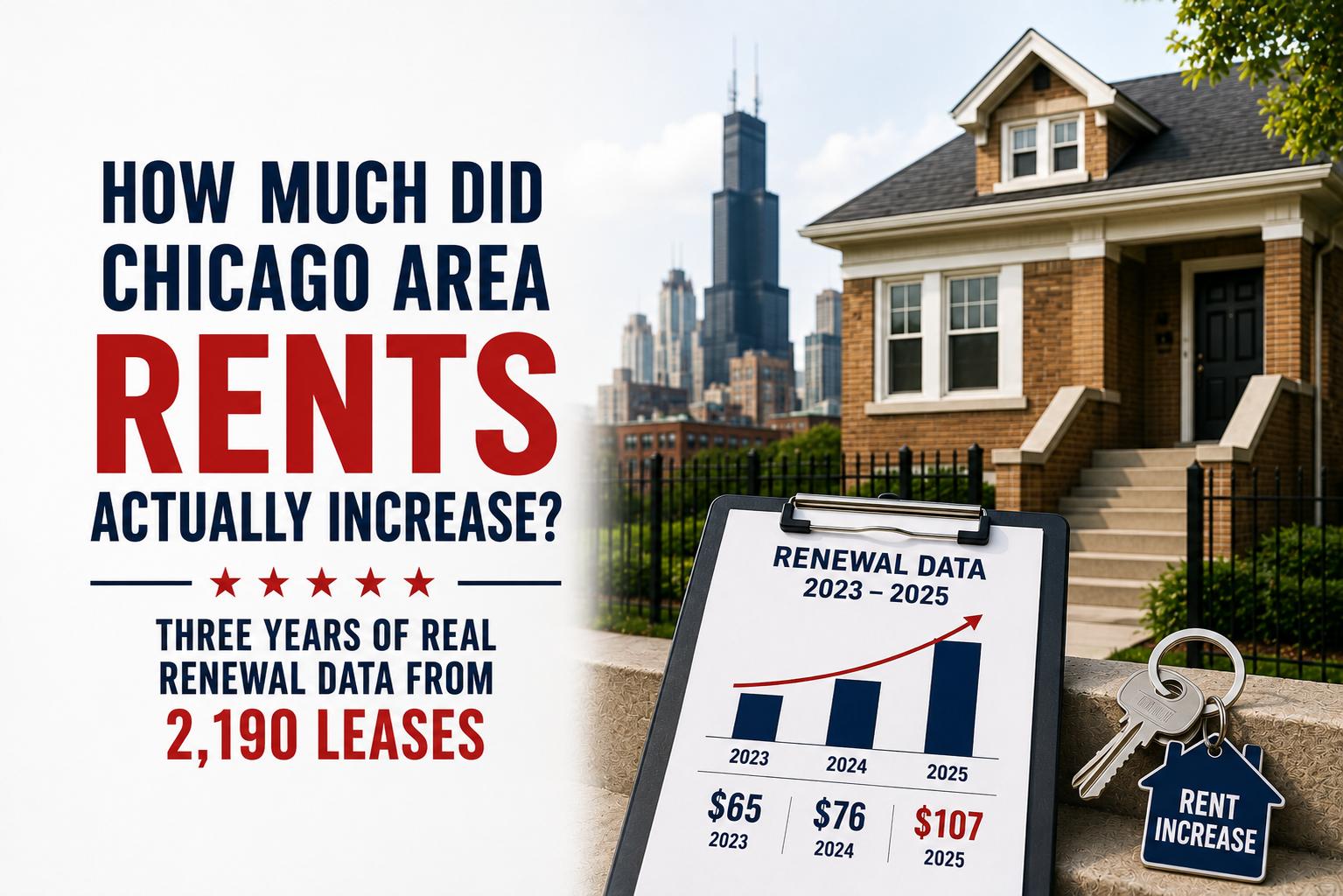
Forget the Zillow estimates. GC Realty & Development analyzed every completed lease renewal across the portfolio from 2023 through 2025 to show what’s actually happening with rents across Cook, DuPage, Kane, McHenry, and the surrounding collar counties.
Every month, Zillow, Apartments.com, and a dozen other platforms publish rent estimates for the Chicago area. Those numbers are based on listing prices, which is what landlords ask for on vacant units. They don’t tell an investor what’s actually happening with the rents that matter most to long-term portfolio returns: the renewals.
Renewals make up the majority of a landlord’s revenue decisions every year. When a lease comes up, it’s a real call with real consequences. Push too hard and the tenant leaves, costing a month (or more) of vacancy plus turnover expenses. Go too soft and money gets left on the table across 12 months of below-market rent.
The GC Realty portfolio of 1,400+ residential units across the Chicago metro delivers a direct line into what’s actually happening. So the team pulled every completed lease renewal from 2023, 2024, and 2025 and ran the numbers. Three years. 2,190 signed leases. Six counties. Here’s what the data showed.
Key Takeaways for Chicago Real Estate Investors
Average monthly renewal increases rose from $65 in 2023 to $76 in 2024 to $107 in 2025 across 2,190 signed leases, a 65% increase in the dollar amount captured at each renewal over two years.
Flat renewals (zero increase) collapsed from 31% of renewals in 2023 to just 7.2% in 2025, signaling a major shift in landlord confidence.
Cook County accelerated from 4.45% average increase in 2023 to 7.04% in 2025 across 1,372 renewals, outpacing every collar county in 2025.
Units under $1,200 per month delivered the largest percentage increases (13.88% in 2025), closing the gap to market rate faster than any other rent band.
The under $1,200 segment is visibly shrinking (164 renewals in 2023 down to 58 in 2025) as successive increases graduate those units into higher rent bands.
Rent decreases remain rare but are trending up, from 0.5% of renewals in 2023 to 4.2% in 2025, almost always as targeted strategic adjustments rather than market weakness.
The Three-Year Trend: Steady Acceleration
The headline is straightforward. Rent increases at renewal have accelerated every single year, both in dollar terms and as a percentage of existing rent. This isn’t a one-year blip. It’s a three-year trajectory.
Metric | 2023 | 2024 | 2025 |
Renewals Processed | 580 | 768 | 842 |
Avg Monthly Increase | $65 | $76 | $107 |
Median Monthly Increase | $60 | $55 | $100 |
Flat Renewals (0% increase) | 31% | 14.8% | 7.2% |
In 2023, the average renewal brought in an extra $65 per month. By 2025, that number hit $107. That’s a 65% increase in the dollar amount captured at each renewal over just two years. Median increases tell the same story: $60 in 2023, $55 in 2024, then jumping to $100 in 2025.
The slight dip in median from 2023 to 2024 is worth noting. It suggests that while top-end increases grew in 2024, the middle of the portfolio held relatively flat. Then 2025 saw broad-based movement across the entire range, pushing both averages and medians sharply higher.
What Happened to Flat Renewals
In 2023, a full 31% of renewals had zero increase, meaning nearly one in three tenants renewed at the same rent. By 2024, that dropped to 14.8%. By 2025, just 7.2%. That’s a dramatic shift in landlord confidence over three years. The Chicago market moved from cautious to assertive.
County by County: Three Years of Divergence
The Chicago metro isn’t one market. Three years of data makes the differences between counties much clearer than any single-year snapshot ever could.
County | 2023 | 2024 | 2025 |
Cook (1,372 renewals) | 4.45% | 5.00% | 7.04% |
DuPage (411 renewals) | 5.83% | 4.91% | 6.34% |
Kane | n/a | 6.30% | 5%+ |
McHenry | n/a | 6.49% | 5%+ |
Cook County Is the Real Story
Cook County is the most statistically significant slice of the dataset with 1,372 renewals over three years. The trajectory went from 4.45% in 2023 to 5.00% in 2024 to 7.04% in 2025. That isn’t gradual. The 2025 jump of two full percentage points represents meaningful acceleration, and average dollar increases hit $116 per month in 2025.
DuPage Had a Different Rhythm
DuPage County showed an interesting pattern. Increases actually dipped in 2024 (from 5.83% to 4.91%) before rebounding to 6.34% in 2025. Across 411 renewals over three years, DuPage has consistently sat in the 5% to 6% range with 2024 as the outlier year.
Kane and McHenry Peaked in 2024
Both Kane (6.30%) and McHenry (6.49%) peaked in 2024 and pulled back slightly in 2025. That suggests the collar counties may have hit a near-term ceiling for percentage increases, even as Cook County continued to accelerate. Both still delivered healthy 5%+ increases in 2025. For investors evaluating suburban markets, the takeaway is that percentage growth has started to plateau in the collar counties while Cook is still climbing.
The Cook County Acceleration Is the Biggest Takeaway
While the collar counties showed a rise-then-flatten pattern, Cook went from middle of the pack in 2023 to leading the group in 2025. For investors concentrated in Cook County, rent growth has been accelerating faster than suburban peers.
The Rent Band Effect: Three Years of Catch-Up Growth
One of the most powerful patterns in this data is the inverse relationship between current rent level and the percentage increase at renewal. That held true every single year.
Rent Band | 2023 | 2024 | 2025 |
Under $1,200 | 7.69% | 7.90% | 13.88% |
$2,500+ | n/a | 2.89% | 4.49% |
Units Under $1,200 Are Doing the Catching Up
Units renting for under $1,200 per month saw the most dramatic movement: 7.69% in 2023, 7.90% in 2024, then an explosion to 13.88% in 2025. That’s an average of $143 per month more on a unit that might have been renting for $1,000. These are properties closing the gap to market rate, and the data shows that gap is narrowing fast.
The under $1,200 segment is also visibly shrinking. It went from 164 renewals in 2023 to just 58 in 2025. Those units didn’t disappear. They graduated into higher rent bands as successive increases pushed them past the $1,200 threshold. Meanwhile, the $1,600 to $1,999 band more than doubled (from 106 to 236 renewals) and the $2,500+ band more than tripled (from 26 to 84 renewals).
Premium Units Grow in Dollars, Not Percentages
At the higher end, the $2,500+ band actually dipped to 2.89% in 2024 before recovering to 4.49% in 2025. Premium units have less room for percentage growth, but they still delivered $131 per month in average increases during 2025. The math just shows up differently: smaller percentages on larger rent bases still produce meaningful dollar growth.
The Rent Band Migration Story
In 2023, 28% of renewals sat under $1,200 per month. By 2025, that’s down to 7%. The $1,600+ bands went from 32% of renewals in 2023 to 53% in 2025. The portfolio is moving upmarket through organic rent growth, not just through new acquisitions.
Where to Go Deeper on Chicago Renewal Data
This three-year view is the widest-angle piece in a larger GC Realty data series on the Chicago rental market. For investors who want the narrower cuts that pair with this analysis:
• 2024 vs. 2025 Chicagoland Lease Renewals and Increases breaks the year-over-year comparison down by quarter across eight full quarters.
• How You Price Your Rental Is Your Competitive Advantage covers the pricing discipline that converts these renewal numbers into actual portfolio income.
• How to Reduce Tenant Turnover Without Lowering Rent in Chicago covers the operational moves that let owners push increases while keeping tenants in place.
Investors who want a read on what a specific Chicagoland property should be targeting at the next renewal cycle can start with a free rental analysis from the GC Realty team.
The Rent Decrease Question
Transparency matters. Not every renewal goes up, and glossing over that would undermine the credibility of everything else in this report.
Year | Renewals with Decrease | Share of All Renewals |
2023 | 3 of 580 | 0.5% |
2024 | 14 of 768 | 1.8% |
2025 | 35 of 842 | 4.2% |
Rent decreases were rare in 2023 (just 0.5% of renewals, or 3 out of 580). They ticked up to 1.8% in 2024 (14 out of 768), then to 4.2% in 2025 (35 out of 842). That upward trend deserves context.
A rent decrease on renewal is almost always a strategic decision. It might be a long-term tenant where the owner wants to lock in stability. It might be a unit where a previous aggressive increase needs correction. Or it might be a property where maintenance issues or neighborhood factors warrant a concession to avoid costly turnover.
4.2% of renewals with a decrease, in a year where the average increase was $107 per month, tells an investor this isn’t a market under pressure. It’s a market where good operators are making targeted adjustments while the broader trend moves firmly upward.
What Three Years of Data Tells Chicago Area Investors
Rent Growth Is Real, and It’s Compounding
The average renewal increase went from $65 to $76 to $107 over three years. That isn’t linear. It’s accelerating. On a $1,500 per month unit, an owner is capturing roughly $1,284 more in annual rent in 2025 than on a similar renewal in 2023.
Cook County Is Leading the Charge
While the collar counties showed a rise-then-plateau pattern, Cook accelerated from 4.45% to 7.04% over three years. The largest county in the portfolio is also delivering the strongest growth trajectory.
Buy Low, Grow Fast
Properties with rents under $1,200 have consistently delivered the highest percentage increases. Investors acquiring below-market units and executing a professional renewal strategy can expect outsized catch-up growth based on what the three-year data shows.
The Flat Renewal Era Is Ending
Zero-increase renewals dropped from 31% in 2023 to 7.2% in 2025. Landlords across the Chicago metro are increasingly confident in pushing rents at renewal. The question isn’t whether to increase anymore. It’s by how much.
This Data Exists Because Someone Tracked It
Most property management companies can’t produce three years of renewal data broken out by county and rent band across 2,190 leases. If a property manager can’t deliver this level of transparency, that’s a conversation worth having.
Frequently Asked Questions About Chicago Area Rent Increases
How much have Chicago area rents actually increased at renewal?
Across 2,190 signed lease renewals from 2023 through 2025, the average monthly increase rose from $65 in 2023 to $76 in 2024 to $107 in 2025. That’s a 65% increase in the dollar amount captured at each renewal over two years.
Which county delivered the strongest rent growth in 2025?
Cook County. It went from 4.45% average increase in 2023 to 7.04% in 2025 across 1,372 renewals, with average dollar increases hitting $116 per month in 2025. DuPage landed at 6.34%, and both Kane and McHenry pulled back slightly from their 2024 peaks but still delivered healthy 5%+ growth.
Are lower-priced rentals seeing bigger percentage increases?
Yes, and it’s the clearest pattern in the dataset. Units under $1,200 per month delivered 13.88% average increases in 2025, compared to 4.49% at the $2,500+ level. That’s the catch-up effect of below-market units closing the gap to current market rates.
Why are there fewer sub-$1,200 renewals now?
Because those units are graduating into higher rent bands. The segment went from 164 renewals in 2023 to just 58 in 2025. Units didn’t disappear. Successive increases pushed them past the $1,200 threshold. The $1,600 to $1,999 band more than doubled in the same period.
How common are rent decreases at renewal?
Rare, but trending up. Rent decreases made up 0.5% of renewals in 2023, 1.8% in 2024, and 4.2% in 2025. Those are almost always strategic decisions to lock in a long-term tenant, correct a previous over-aggressive increase, or address a unit-specific issue, rather than evidence of a weakening market.
Are Zillow or Apartments.com rent estimates reliable for Chicago?
They reflect asking prices on vacant listings, not what tenants actually pay on executed renewals. Renewals are the majority of a landlord’s annual revenue decisions, and renewal pricing moves differently than listing pricing. Relying solely on public listing estimates understates what well-managed Chicago rentals are actually capturing at renewal time.
What should Chicago investors be doing with this data?
Using it to benchmark. If renewal increases across the portfolio are running well below the 2025 county and rent-band numbers in this report, that’s a signal to review pricing discipline and the renewal conversation process. If renewal rates are collapsing alongside larger increases, that’s a signal to look at retention operations. The data provides a market benchmark; the owner’s portfolio provides the comparison.
Chicago Rent Growth Is a Portfolio-Level Opportunity
Three years of data across 2,190 leases and six counties tells a consistent story. Chicago area rents are moving up meaningfully at renewal time, Cook County is leading the charge, lower-priced units are catching up fastest, and the era of flat renewals is effectively over. The investors who capture this opportunity are the ones with the data, the renewal discipline, and the operations to execute on every property.
Investors who want GC Realty & Development running the renewal strategy, pricing analysis, and operational discipline that produced these three-year numbers can call the office at 630-587-7400 or start with a free rental analysis to see what a specific property should be earning at the next renewal cycle.
Methodology
This analysis includes all completed lease renewals processed through GC Realty & Development’s portfolio for calendar years 2023 (580 renewals), 2024 (768 renewals), and 2025 (842 renewals). Data is sourced from actual executed lease agreements across Cook, DuPage, Kane, McHenry, Will, Lake, and Kendall counties. Percentage and dollar increases are calculated from the difference between the previous lease rent and the new renewal rent. County data is sourced directly from the property management system. Rent bands are based on the pre-renewal (previous) rent amount.