



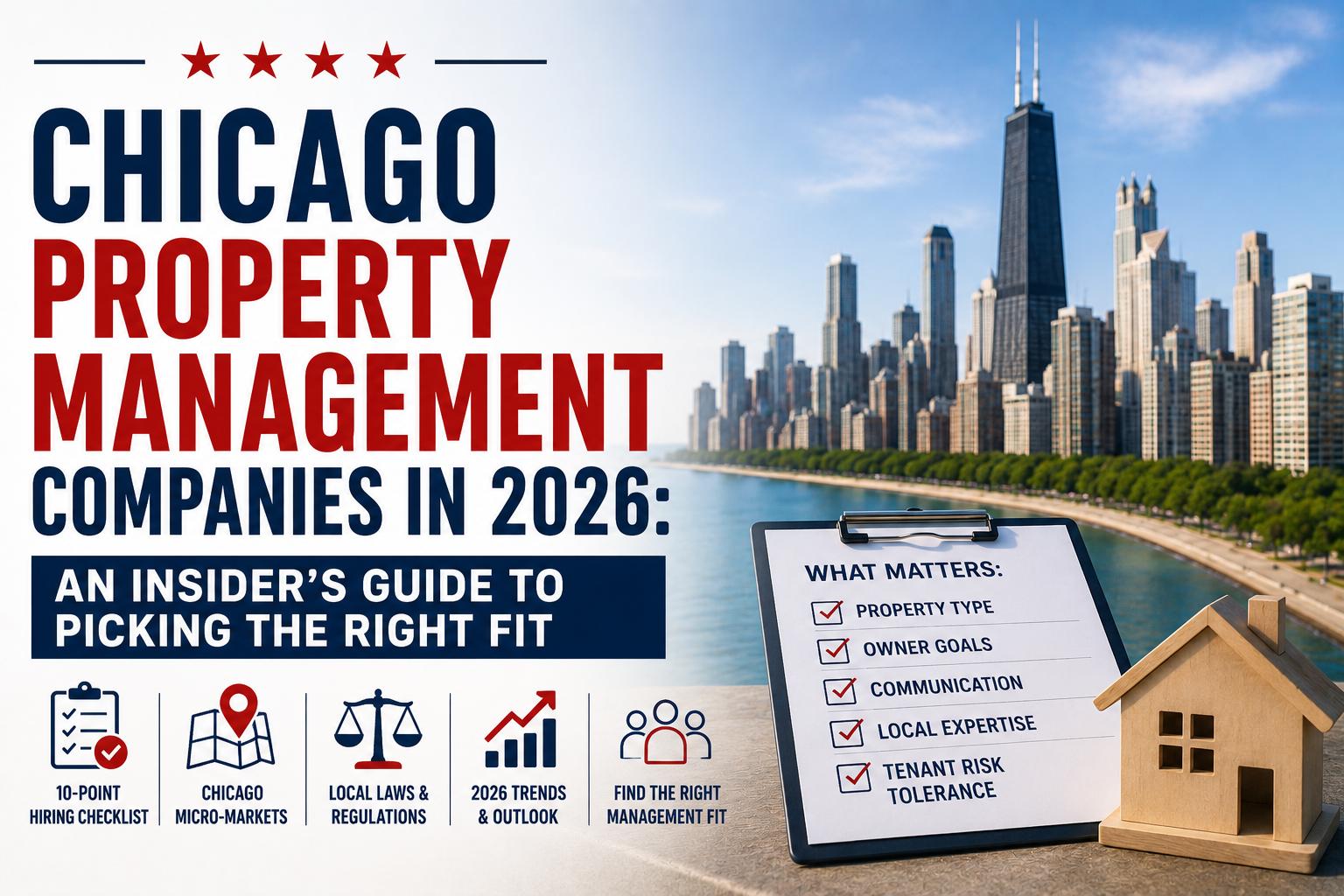
Mark Ainley has spent over 20 years managing rental property across Chicago and the suburbs. Through that work and hundreds of episodes of the Straight Up Chicago Investor Podcast, he has gotten to know many of the top property management firms in this market personally. That perspective is exactly what makes this list different from anything else on the internet.
Chicago is one of the most intriguing real estate markets in the country. Between tenant-friendly laws, neighborhood-by-neighborhood rent dynamics, and an ever-shifting regulatory layer, managing rental property in this market requires a lot more than just collecting rent.
That’s why more landlords (from first-time owners to seasoned investors) are turning to professional Chicago property management companies to protect and grow their portfolios. This guide breaks down:
What makes managing property in Chicago genuinely different from other markets
How to find the right property management company for a specific investor profile
A curated list of Chicagoland firms worth knowing, based on real, first-hand relationships
Key Takeaways for Chicago Real Estate Investors
Chicago property management is genuinely harder than other markets, thanks to the multi-layered legal environment (RLTO, Cook County RTLO, Evanston RTLO, Fair Notice Ordinance, crime-free housing programs).
Chicago is a city of micro-markets. A firm that excels in Lincoln Park may not excel in Rogers Park or Garfield Ridge.
2026 is bringing more technology, more regulation, and some private equity entry into Chicago property management.
The right company depends on property class, owner involvement preferences, communication speed needs, and strategy (buy-and-hold vs. BRRRR vs. short-term).
Large firms win on scalability. Boutique firms win on hands-on service. There isn’t a universally “best” answer; there’s only the best fit.
The 10-point hiring checklist at the end of this guide catches the red flags most landlords miss when selecting a firm.
Why Managing Rental Property in Chicago Is Genuinely Different
A lot of landlords moving from other cities (or even other parts of Illinois) ask the same question: why is property management in Chicago so much more difficult than other markets? Three reasons stand out.
1. A Multi-Layered Legal Environment
Chicago landlords don’t just need to know landlord-tenant law. They need to know multiple stacked layers of it:
• Chicago Residential Landlord Tenant Ordinance (CRLTO)
• Cook County Residential Tenant and Landlord Ordinance (RTLO)
Crime-free housing programs (vary by suburb)
Miss one notice, one procedure, or one Chicago security deposit handling rule, and an owner could owe triple damages or see an eviction case tossed entirely.
2. Hyper-Localized Rental Markets
Rental rates and tenant expectations in Lincoln Park are different from Rogers Park, which are different from Garfield Ridge. Chicago is a city of micro-markets, and those lines sometimes change block by block. A property manager who knows “Chicago” in general is not the same as a property manager who knows a specific submarket.
3. Weather and Maintenance Challenges
The Chicago weather swings between brutal winters and hot, humid summers. Deferred maintenance can turn small problems into major, expensive disasters faster than in temperate markets.
How the Chicago Property Management Industry Has Changed in 2026
A few major trends have reshaped the Chicago property management landscape heading into 2026.
Technology Expansion
AI-driven screening tools, owner and tenant portals, maintenance tracking apps, and virtual tours are now standard for competitive firms. At the same time, rental scams are hitting Chicago landlords every day, and most individual owners can’t plan for or protect against them without professional help.
Increased Regulation
New tenant protections arrive every year. Multiple new laws and regulations took effect January 1, 2026, and the trend isn’t slowing down.
Private Equity Entry
Some larger, national firms are now managing thousands of Chicago units. For most, the transition into this market has been rougher than expected.
Professionalization of Smaller Firms
Many mid-sized local companies have leveled up their systems, staffing, and service quality, closing the gap between boutique operators and institutional players on operational sophistication.
How to Pick the Right Chicago Property Management Company for You
Not every landlord needs the same kind of manager. Before interviewing any firm, work through these five questions.
Question 1: How Much Control Do You Want?
Full-service or hands-off management?
Do you prefer leasing-only services?
Do you want to be consulted on every maintenance issue, or do you want a team to solve problems on your behalf?
Question 2: What’s the Property Class?
“A” class: downtown Chicago condo or near-north neighborhoods like River North, Lakeview, or Old Town
“B” or “C” class: two-flat in certain neighborhoods
“D” class: multi-family in tougher areas
“A-C” class property in any of the 128 Chicago suburbs
Question 3: How Important Are Speed and Communication?
Comfortable with 48-hour response windows?
Or do you need same-day answers?
Question 4: What’s Your Investment Strategy?
Buy-and-hold investors need a different partner than 1-2 year equity plays.
BRRRR strategies need a manager who can coach through gut rehabs or value-add projects, and only a handful of firms genuinely can.
Question 5: What’s Your Tenant Risk Tolerance?
Some landlords accept slightly riskier tenants with larger security deposits.
Others prefer a conservative screening profile.
Know the answer to each of these first. Then pick the property manager whose style and systems reflect those answers.
Large vs. Boutique: How Chicago Firms Stack Up
Feature | Large Property Manager | Small / Boutique Property Manager |
Coverage | Multi-city, multi-state | Specific neighborhoods, suburbs |
Staff Size | Big call centers, multiple offices | Small, local team |
Processes | Very standardized, little flexibility | Highly adaptable, more customized |
Communication | Slower, often through portals only | Faster, more personal |
Cost | Sometimes lower fees (economies of scale) | Often higher but more personalized service |
Known For | Big portfolios, absentee landlords | Individual owners, small-to-midsize investors |
The bottom line: larger property management firms tend to be better for scalability within an owner’s portfolio, while smaller boutique firms tend to deliver a more hands-on experience. The main thing that actually matters is whether an owner trusts the Chicago property manager they’re working with.
Property Management Companies Worth Knowing in Chicago 2026
These are firms with genuine operational reputations in the Chicago market, each with a distinct specialty.
1. Chicago Style Management
Focus on C and D class neighborhoods
South side of Chicago focus
Willing to manage properties that most firms avoid
Deep local connections on the south side and south suburbs
Coverage includes West Lawn, Englewood, Auburn Gresham, Greater Grand Crossing, Woodlawn, and South Suburbs
Experienced with Section 8 housing and voucher holders
Best For: Landlords willing to take more risk for higher cash flow.
2. Landmark Property Management
Based in the Pilsen area and Will County
Specializes in Pilsen, Little Village, Joliet, and south suburban markets
Strong presence in workforce housing management
Best For: Will County investors and the near southwest side of Chicago.
3. Marblestone Property Group
Focuses on South and Southeast Chicago
Office located directly within their coverage area
Known for hands-on management and tenant retention
Expertise in subsidy programs and government compliance
Coverage includes South Shore, Deering, East Side, Pullman, Roseland, West Pullman, and South Chicago
Best For: Owners investing in the southeast side.
4. Concierge Property Management LTD
Based in Lake County
Strong focus on suburban single-family home management
Personalized boutique service
Best For: Far north suburban investors prioritizing service and local knowledge.
5. GC Realty & Development (That’s Us!)
20+ years of experience across Chicago and suburbs
Specialize in A, B, C, and even D class properties
On the front lines of every new ordinance change
Focused on building the portfolios of real estate investors
Experienced with out-of-state owners
• Strong education platform (Straight Up Chicago Investor Podcast)
Best For: Investors who want hands-off management plus proactive communication and investor-minded strategy. Learn more here.
Common Hiring Mistakes Chicago Landlords Make
Across 20+ years of watching investors pick (and sometimes regret picking) a property manager, a few patterns come up repeatedly.
Picking Solely on Price
Cheap management often costs more down the road in vacancy, poor tenants, and deferred repairs. The monthly fee is the smallest number in the operational equation.
Ignoring Online Reviews
Check Google, Yelp, BBB, and Facebook. More importantly, read how the company responds to bad reviews. That response pattern reveals the operational culture more clearly than the reviews themselves.
Not Asking About Staff Turnover
If the assigned property manager leaves every six months, service quality plummets. Ask directly: who will I be working with, and how long have they been with the company?
Skipping the Maintenance Policies
Some companies upcharge 15 to 25% on maintenance. That needs to be disclosed up front, and the answer affects the real total cost of management more than the headline management fee.
Assuming They Know Your Neighborhood
Always ask: how many units do you currently manage within five miles of my property? The answer separates genuine local expertise from marketing claims.
Chicago Landlord Resources Worth Bookmarking
For landlords still in the learning phase, these resources cover the ordinances and operational realities that every Chicago property manager needs to handle correctly:
• The Chicago RLTO explained covers the city’s core landlord-tenant framework.
• What You Must Know About the Cook County RTLO is GC Realty’s free ebook on suburban Cook County compliance.
• 2026 Illinois landlord law changes covers what took effect January 1.
Owners wondering what their specific property could command and how quickly it should lease can start with a free rental analysis from the GC Realty team.
Looking Ahead: Where Chicago Property Management Is Going
The next wave of changes Chicago property management is bringing:
More strict eviction rules for landlords to follow
More mandatory licensing requirements for managers
Possible removal of non-refundable move-in fees
Caps on how much landlords can charge for late fees
Caps on how much landlords can charge for rental applications
New approaches to Chicago squatter issues
• Continued push for sustainability upgrades (Evanston is on the forefront here)
More smart technology adoption: self-showings, rent payment apps, AI screening
The best Chicago property management companies are already preparing for all of this. If your current manager isn’t, it might be time to upgrade.
Protect the Investment. Protect the Sanity.
Owning property in Chicago is an incredible opportunity. Managing it yourself, or with the wrong partner, is a genuine risk. The right property management company in Chicago means:
You buy back your time
You reduce your operational risk
You no longer need to be on call 24/7
You have a consistent process for rental applicant approval and rent collection
Maintenance costs are at or below market, without you coordinating any of it
The 10-Point Chicago Property Management Hiring Checklist
Before hiring any Chicago property management firm, work through these ten checks. Red flags on any of them should trigger a move to the next firm on the list.
Google review star rating 4.0 or higher?
Does the way the company responds to negative Google reviews sit well with you?
Once you inquired, did the property management company respond the same day or sooner?
Professional-looking, up-to-date website and sales material?
Licensed with the State of Illinois?
Content online where you can watch and learn about the company and their team?
Positive company culture on Glassdoor reviews?
Social media presence and public interactions are professional?
Is the Property Management Agreement easy to understand, and does the company explain every section clearly?
In-house maintenance team to control costs?
Frequently Asked Questions About Chicago Property Management
What makes Chicago property management different from other markets?
Three things: multi-layered legal compliance (RLTO, Cook County RTLO, Evanston RTLO, Fair Notice Ordinance, crime-free housing programs), hyper-localized rental markets where rents and tenant expectations change block by block, and severe weather cycles that turn deferred maintenance into expensive emergencies quickly.
Should a landlord hire a large firm or a boutique firm?
It depends on portfolio scale and communication preferences. Large firms tend to win on scalability, standardized processes, and sometimes lower fees. Boutique firms tend to win on hands-on service, adaptability, and faster, more personal communication. The right answer is whichever model matches the investor’s own style.
How much does a Chicago property manager typically cost?
Monthly management fees are the headline number, but the real total cost depends heavily on maintenance upcharges (some firms add 15 to 25%), leasing fees, renewal fees, and other line items. Ask for a full fee schedule up front.
What’s the single best question to ask when interviewing a Chicago property manager?
“How many units do you currently manage within five miles of my property?” That answer separates firms with genuine local expertise from firms that list every Chicago zip code on their website but haven’t actually operated in a specific submarket.
Is it worth paying more for an in-house maintenance team?
Usually yes. An in-house team generally controls costs better than a firm that sub-contracts every work order, because the firm has direct visibility into labor rates, parts pricing, and response times. Sub-contracted maintenance often produces surprise upcharges.
What about companies that specialize in one specific Chicago submarket?
They can be excellent, especially in tougher neighborhoods where genuine operational knowledge matters more than national brand recognition. Firms like Chicago Style Management on the south side or Marblestone Property Group on the southeast side bring real local expertise that a generalist firm can’t replicate.
How often should a property manager be providing updates?
At minimum, monthly statements with real-time portal access for maintenance and leasing activity. For high-touch owners, weekly or bi-weekly check-ins are reasonable. The right cadence is whatever matches the owner’s preference, but the firm needs to deliver on that cadence consistently.
Ready to Protect and Grow the Investment?
A note from GC Realty & Development: we’ve been around for 23 years. The team has leased over 5,000 Chicagoland properties and worked with more than 1,000 investors. We are real estate investors ourselves. The company’s first property management client from 2003 sold their property in 2023, and the second longest-standing client still works with us today.
At the end of the day, hiring a property manager is about finding the right fit. Not every investor is the right fit for every property management company, and not every property management company is the right fit for every investor. The goal of this guide is to help Chicago landlords ask the right questions, know what to look for, and land with a partner who genuinely reflects their goals and style.
No one expects a landlord to hire a firm off one email or blog post. But a 15-minute call is worth it to find out if GC Realty is the right fit for a specific investor profile. Schedule a 15-minute call here, or check out the FAQs page for quick answers first. The Chicagoland market is full of good operators; the best decision any owner can make is picking the one that matches their specific investment style.