



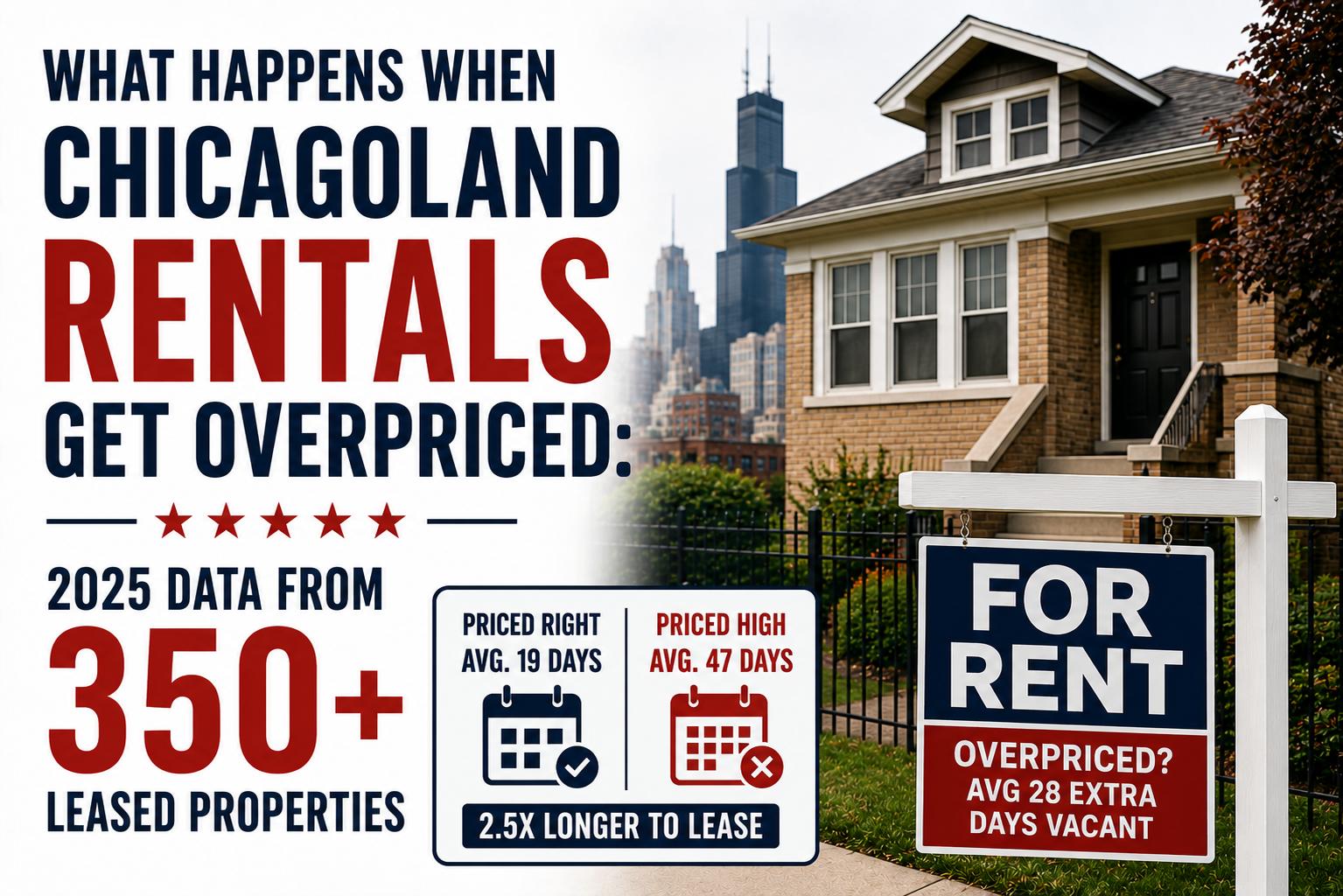
Pricing a rental property is more art than science. After 23 years of leasing over 5,000 investment properties across the Chicago metro area for both outside investors and personally, Mark Ainley and the GC Realty & Development team have learned that getting the price right is the single most important decision in the leasing process. Not marketing. Not photos. Not timing. Price.
And when the price gets missed (whether that’s on the property manager or because the owner pushed past the recommended range) the data shows a painful delay before rent actually starts coming in.
To quantify what that delay actually costs, GC Realty analyzed over 350 completed leases from the 2025 portfolio. The exercise was useful internally and produced lessons every investor in the Chicago market should see.
Key Takeaways for Chicago Real Estate Investors
Across 350+ completed leases in 2025, properties priced within the GC Realty recommended range leased in an average of 19 days.
Properties that ended up leasing below the recommended range took an average of 47 days, roughly 2.5 times longer.
Those below-range properties usually leased at the same final rent the recommended range would have produced, just with 28 extra vacant days attached.
77.3% of leases landed within the GC Realty recommended range, and 44.9% landed in the top quarter of that range.
Most renters look at only 5 to 7 properties before making a decision, so any listing priced in the top half of comparable inventory risks never getting a showing at all.
Overpricing gets materially more expensive heading into the fall and winter months as demand thins out.
How GC Realty Builds the Recommended Rent Range
For every property under management, GC Realty provides a recommended rent range of approximately $200. The spread is intentional: it sets expectations for the worst case through best case outcome an owner can realistically expect.
A common question from owners is, “How long will it take to lease my property?” The answer always starts with the same phrase: “If we price it right within the suggested range, then…”
Here’s how the range gets built, step by step.
Step 1: What Has Actually Leased Recently?
The process starts with comparable properties that leased in the last 60 days. That baseline establishes what tenants are actually paying in the area right now. Those numbers can’t be taken at face value, though, because every comp has differences from the subject property that need to be adjusted for. GC Realty often pulls comps from the internal portfolio that most investors wouldn’t have access to, because those properties leased before they ever hit the open market.
Step 2: Adjust for Seasonality
The Chicagoland rental market moves in cycles, and a property that leased in September doesn’t tell an owner what the same property will lease for in November. The market slows in fall and winter, picks up in spring, and peaks in summer. If a property is getting listed in February, a December lease price can’t be taken as gospel because December is one of the slowest months of the year. The range has to include an educated adjustment based on where the calendar sits in the seasonal cycle.
Step 3: What Is on the Market Right Now?
This is where most people stop looking, but it’s actually the most important step. Past leases give a general sense of direction, but active listings show what a property is actually competing against right now. How many comparable properties are listed? What are they asking? This comes down to straight supply and demand, and even during busier months, there are weeks when inventory is simply flooded.
Step 4: Account for Area Density
Not all inventory is created equal. Fifteen competing listings in a section of Lakeview or Ukrainian Village is a completely different situation than three competing listings in a far-west suburb like Hampshire, where perhaps five people move in and out of the area in a given month. The same number of competing listings can mean very different things depending on the size of the tenant pool in that specific market.
This ties back into seasonality. Fifteen comparable listings in a corner of Lakeview during peak summer is manageable because tenant demand is high. Fifteen comparable listings in Lakeview in December is a much bigger problem.
Step 5: Where the Property Actually Needs to Be Priced
Here’s the reality most owners don’t think about. If there are 15 comparable properties on the market, a listing needs to be priced in the lower 50% of that group. Why? Because most renters are only going to look at 5 to 7 properties before making a decision. If they’re sorting by price from low to high, and a listing sits in the top half of comparable inventory, the property may never even get a showing. It doesn’t matter how nice the property is if no one walks through the door.
Why Pricing Alignment Before Listing Matters
One of GC Realty’s biggest goals, especially with new clients, is getting aligned on the recommended range before a property ever hits the market. Every owner should walk in understanding what the worst case and best case outcomes look like for their final rent. When everyone agrees on expectations upfront, the leasing process runs smoothly. When the owner and the property manager are not on the same page, the process gets far more difficult than it needs to be.
How the GC Realty Recommended Range Performed in 2025
Here’s how more than 350 leased units in the 2025 portfolio performed against the GC Realty recommended range:
Category | Count | Percentage |
Top 25% of Range | 158 | 44.9% |
Within the Range | 272 | 77.3% |
Below the Range | 76 | 21.6% |
Above the Range | 4 | 1.1% |
A 77.3% accuracy rate is something to be proud of. Nearly half of all units landed in the top quarter of the recommended range, which means the range analysis is consistently helping owners capture strong rent. The real lesson, though, is in the 76 properties that leased below the range. That’s where the pricing discipline story lives.
Why GC Realty Misses on Price
When the price gets missed, it generally comes down to one of two reasons.
Reason 1: The Owner Starts Higher Against the Data
This is the most common scenario. An owner looks at the recommended range and wants to test a higher price point. GC Realty pushes back when possible, but at the end of the day, it’s the owner’s property and their decision. Sometimes there’s no way to get alignment on the range, and the listing goes to market above where the data says it should be.
Reason 2: There Aren’t Strong Comparables
Not every property has five nearly identical units that leased nearby in the last 60 days. Not every area has enough active listings to gauge current supply and demand. When strong comparable data (either recent leases or current listings) simply isn’t available, the recommended range becomes an educated estimate with more room for error.
A recent example: a very unique single-family home in Elmhurst. Perfect location, good size, quality property. But nothing comparable had leased within half a mile in the last three years. Was it a $4,500 rental or a $5,500 rental? Honestly, the team didn’t know for sure. In cases like that, the approach is to start at the higher end of the range and work down, trusting that strong marketing will surface whatever demand exists. If there’s traction at $5,300 to $5,500, great. If there’s no demand at that level, it was overshot and the price gets adjusted. That’s not a failure; it’s the only way to find the market when data doesn’t exist.
Regardless of the reason, when a property starts too high the result is the same. The data makes it painfully clear.
What Actually Happens When a Listing Starts Too High
When a property goes to market above where it should be, it doesn’t just miss on price. It misses on time. And time is where the real cost lives.
Metric | Within Range | Below Range |
Properties | 272 | 76 |
Average Days on Market | 19 days | 47 days |
Median Days on Market | 13 days | 43 days |
Properties priced within the recommended range leased in an average of 19 days. Properties that ended up leasing below the range took 47 days. That’s 2.5 times longer.
Here’s the part that really stings: those properties still ended up leasing at or below the price the GC Realty team originally recommended. The extra time on market did not result in a higher rent. It resulted in the same rent (or worse) after burning almost a month of extra vacancy.
Where to Go Deeper on Chicago Rental Pricing
Pricing discipline sits underneath almost every performance metric that matters in a rental portfolio. For investors who want to build out the full pricing and leasing framework, a few related GC Realty resources pair directly with this analysis:
• How You Price Your Rental Is Your Competitive Advantage breaks down why pricing is the single biggest lever an investor has in either market.
• A Comprehensive Guide to Rental Analysis in Chicago walks through the full pricing methodology behind what a Chicago rental should actually command.
• Free Vacancy Loss Calculator turns extra days on market into a real dollar figure for any specific property.
Investors who want a read on what a specific property should actually be renting for can start with a free rental analysis from the GC Realty team.
The Real Cost of a Vacant Property
When people think about the cost of overpricing, they usually think about lost rent. Yes, that’s a big piece. But the true cost of a property sitting vacant goes well beyond the rent check the owner isn’t receiving.
Lost Rent
This one is obvious but worth stating clearly. Every day a property sits empty is a day of rent the owner will never recover. It doesn’t matter what the property eventually leases for. Those vacant days are gone. If a property takes 47 days to lease instead of 19, that’s 28 days of income that evaporated because the listing started in the wrong place. The GC Realty free vacancy loss calculator turns that into a real dollar number for any specific rental. It’s just a math problem.
Utility Payments
While the property is vacant, someone has to keep the lights on (literally). Electric, gas, water. None of those bills stop just because there’s no tenant. In the winter, heat runs to keep pipes from freezing. In the summer, climate control may need to run enough to keep the property in showing condition. The longer a property sits, the more those utility bills add up, and every dollar comes out of the owner’s pocket.
Risk of a Vacant Property
A vacant property is an exposed property. Pipes can freeze and burst in winter when nobody is there to notice. A small leak can go undetected for weeks and turn into a major repair. Break-ins, vandalism, and squatters are real risks in certain parts of the Chicago metro. The longer a property sits empty, the more risk the owner is carrying. None of that risk would exist if the property had been priced right and leased on time.
Stress, Frustration, and Owner Time
This is the cost that doesn’t show up on a spreadsheet but often hits the hardest. If the owner is the one showing the property, every extra week on the market means more trips out, more time carved out of the day, more showings that go nowhere. Fielding calls, coordinating schedules, driving to the property, waiting for prospective tenants who may or may not show up, all while knowing the listing is overpriced and the market is saying so. That wears on people. Multiply the effect across several weeks and across multiple properties and it’s no longer just a financial cost. It’s a quality-of-life cost.
How Overpricing Plays Out in the Real World
Two versions of the same story show up over and over.
Scenario A: Start High, End Up in the Range
Recommended range is $2,000 to $2,200. The owner wants to try $2,500. Or the comps were thin and the initial range was off. Either way, the property hits the market above where the market actually sits.
It sits. Showings trickle in but nobody bites. After a few weeks, the price gets adjusted. Eventually it leases at $2,100.
The property landed exactly where the market said it would. The only difference? It took 28 extra days to get there, with all the lost rent, utility costs, risk, and frustration that come with it.
Scenario B: Start High, End Up Below the Range
Same starting point, but this time the property sits even longer. The listing goes stale. Prospective tenants scroll past it because it’s been on the market for weeks. The owner gets nervous and agrees to a bigger price cut. It finally leases at $1,795.
Now the owner has lost the vacancy time AND ended up below the range. They’re collecting less rent every single month for the duration of the lease on top of all the vacancy costs they already absorbed. This version of the story happened 76 times in the 2025 portfolio.
Overpricing Is Much Worse Heading Into the Fall
Everything described above gets significantly worse when a property gets overpriced heading into the fall and winter months.
In the summer, an overpriced listing at least lives in a market with strong demand. Plenty of renters are actively looking, and even an overpriced listing gets some traffic. There’s a cushion. In the fall, that cushion disappears.
Here’s what happens when overpricing hits the slower months:
New competing listings come to market at lower prices because those owners and property managers can see demand slowing down.
Existing competition starts dropping prices because they’re worried about sitting vacant through the winter.
The pool of renters actively searching gets smaller by the week.
The listing isn’t just overpriced anymore. It’s overpriced in a market that’s actively moving away from it. Every price drop is already behind where the market has shifted since the listing went live. The owner is chasing the rental market down and never catching up.
In the summer, an overpriced listing might sit for a few extra weeks before finding the right tenant. In the fall, that same overpriced listing can sit for months because the market deteriorates around it. By the time two or three price adjustments have happened, the calendar is deep into November or December with demand at its lowest point of the year. Now the owner is either accepting a significantly lower rent than they would have gotten in September, or they’re carrying a vacant property through the holidays and into the new year.
This is why the pricing conversation matters so much, especially heading into Q4. The margin for error gets thinner every week once September hits.
What GC Realty Has Learned (and What’s Changing)
This data isn’t just for owners. GC Realty is using it to get better internally too.
For properties in areas with limited comparables, the team is building deeper datasets by tracking every lease outcome, price adjustment, and days-on-market figure across the 1,400+ property portfolio. The more data points collected, the more accurate the initial ranges become, even in neighborhoods where traditional comps are thin.
For new client relationships, GC Realty is putting even more emphasis on the pricing conversation before the listing goes live. Every owner should understand the range, understand what the worst case and best case outcomes look like, and understand the real cost of starting too high. Because the data is clear: the properties that perform best are the ones where the owner and the property manager are aligned on price from day one.
Frequently Asked Questions About Pricing Chicago Rentals
What’s the real cost of overpricing a Chicago rental?
In the GC Realty 2025 dataset, properties that leased below the recommended range took 47 days on average, compared to 19 days for properties priced within the range. The overpriced properties generally ended up at the same rent (or lower) anyway, so the 28 extra days of vacancy produced no upside. Those are days the owner will never recover.
How accurate is the GC Realty recommended rent range?
77.3% of leases in the 2025 portfolio landed within the recommended range, and 44.9% landed in the top quarter of that range. Only 1.1% closed above the range, and 21.6% closed below.
Why does starting high hurt so much in Chicago?
Most renters only look at 5 to 7 properties before making a decision. When they sort comparable listings by price from low to high, a property priced in the top half of the comp set often never gets viewed at all. It doesn’t matter how nice the property is if nobody walks through the door.
Does overpricing a rental make the fall season riskier?
Yes, significantly. In summer, an overpriced listing still benefits from strong baseline demand. In fall, new competing listings come in lower, existing competition cuts prices, and the renter pool shrinks every week. An overpriced fall listing ends up chasing the market down while never catching up, often sitting into November or December.
What happens in the rare case where there are no good comps?
When recent comparable leases don’t exist and active competing listings are thin, the recommended range becomes an educated estimate with more room for error. The right approach is usually to start at the higher end of the range and work down based on actual demand, then adjust the price quickly if showings and interest don’t materialize. That’s not a failure of the process; it’s the only way to find the market when the data isn’t there.
What’s the single biggest lever a Chicago landlord has on leasing speed?
Pricing discipline in the first 48 hours after going to market. The data from 350+ leases in 2025 is unambiguous: the owners who get alignment on the recommended range before the listing goes live consistently lease faster and at market rent. The owners who test higher prices end up at the same rent (or lower) with an extra month of vacancy attached.
The Bottom Line on Pricing a Chicago Rental
After 23 years managing properties across Chicago, the data tells the same story every time.
When the price is right, properties lease in 19 days. When the price is wrong, they take 47 days and end up at the same rent anyway.
The GC Realty recommended range hits target 77% of the time, and nearly half of all units lease in the top quarter of that range. That’s not luck. That’s 23 years of Chicago market experience backed by data from 1,400+ properties.
The question isn’t whether a property might possibly get $200 more per month. The question is whether that possibility is worth the lost rent, the utility bills, the property risk, and the stress and wasted time that come with an overpriced listing. The 2025 data says it isn’t.
Price it right. Lease it fast. That’s how returns get maximized.
Get the Pricing Conversation Right Before the Listing Goes Live
Every overpriced listing in the 2025 dataset had the same starting point: an early pricing decision that got made before the market data was fully absorbed. The 19-day leases and the 47-day leases didn’t differ on marketing, photos, or timing. They differed on one thing: whether the owner and the property manager were aligned on the right range before the property ever hit the market.
Investors who want GC Realty & Development delivering a data-backed rent analysis and running the leasing process that produced these 2025 numbers can call the office at 630-587-7400 or start with a free rental analysis to see what the property should actually be earning and how quickly it should be leasing in today’s market.