



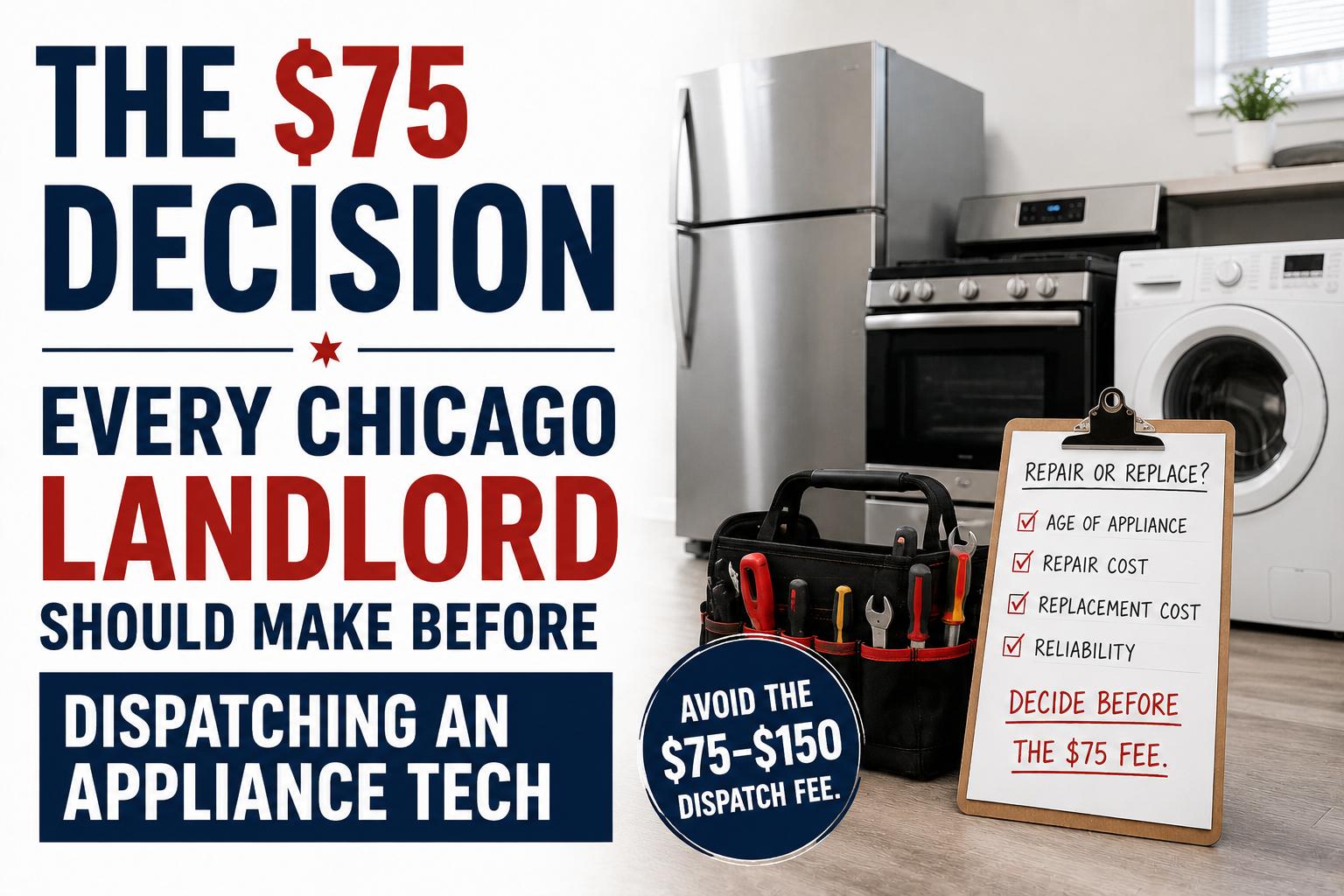
Every landlord has been here. A tenant calls with something broken in one of the units. The natural first move is to send a repair tech out to take a look. But the problem with that approach: the repair or replace decision really needs to happen before anyone gets dispatched. Because once that tech shows up, the bill starts at $75 to $150 for a trip charge, a diagnostic fee, or both. If the appliance ends up being replaced instead of repaired, that money is gone.
So how does a Chicago landlord make the call without a tech on site? With data. The GC Realty & Development team tracked 1,552 appliance work orders across a 1,400+ unit portfolio over the last two years, and now the numbers are clear on what the average repair costs for every major appliance, how often those repairs actually stick, and at what point the smarter move is just buying new. If a landlord knows the age of the appliance and what type it is, a smart decision can get made before anyone pulls up to the property.
Key Takeaways for Chicago Real Estate Investors
Across 1,552 work orders, the average appliance repair costs $279 and the average replacement runs $646. That’s a repair-to-replacement ratio of 43%.
76% of appliance work orders were repairs, meaning the default math favors repairing most of the time.
Microwaves flip the math. Their average repair costs 72% of replacement, and 74% of microwave repair calls exceed 50% of replacement cost.
Washers are the clearest repair situation at 30% of replacement cost; dishwashers sit right at the 51% threshold.
119 repeat repair situations in the 2024-2025 portfolio averaged $761 in total cost, and 28 of those eventually ended in replacement anyway.
The $75 to $150 diagnostic fee every dispatched tech charges should be the forcing function for owners to run the decision framework upfront.
The Average Repair Costs 43% of a Replacement
That’s the starting point for any repair-versus-replace decision. Across the GC Realty portfolio, the average appliance repair runs $279 and the average replacement runs $646. On average, a repair costs about 43% of what a full replacement would. That means most of the time, repairing makes financial sense. The data backs it up: 76% of appliance work orders over the last two years were repairs.
Averages don’t tell the whole story, though. The repair-or-replace math changes dramatically depending on which appliance is on the work order.
Appliance | Avg Repair as % of Replacement |
Washer | 30% (clear repair situation) |
Portfolio average (all appliances) | 43% |
Dishwasher | 51% (at the threshold) |
Microwave | 72% (almost always replace) |
A washer repair runs 30% of a replacement on average. That’s a clear repair situation in almost every case. A dishwasher repair is already at 51% of replacement cost. A microwave repair is at 72%. When the repair cost approaches the cost of a brand-new unit, the data is telling an investor something.
Microwaves Are Almost Always a Replace
This was the clearest signal in the GC Realty data, and it’s worth repeating because it’s the single most consistent pattern in the whole portfolio. 74% of microwave repair calls exceeded 50% of the average replacement cost. The average microwave repair came in at $325.
Compare that to what it actually costs to replace. A retailer like ABT in Glenview can install a brand-new over-the-range microwave for around $425 all in. That’s 72 cents on the dollar to keep an aging unit alive when a new one with a manufacturer warranty is barely more.
Unless the issue is something dead simple like a broken handle where a part can be ordered directly, replace the microwave. The data confirms it at the vendor level too: 38% of microwave work orders ended in replacement anyway, the highest replacement rate of any appliance in the dataset, because vendors on-site keep telling owners the same thing.
The “Repair Twice, Replace Anyway” Trap
This is where the data gets really interesting. Across the two-year dataset, 119 situations showed the same appliance at the same property getting repaired two or more times.
Metric | 2024-2025 Portfolio Data |
Repeat repair situations (same appliance, 2+ visits) | 119 |
Average total cost per repeat situation | $761 |
Repeat situations that ended in replacement anyway | 28 of 119 (roughly 1 in 4) |
The number that should make every Chicago investor pay attention: 28 of those 119 repeat situations eventually ended in a full replacement anyway. Those owners paid for multiple repairs AND still had to buy a new appliance on top of it.
Here’s how that plays out on a single unit:
The Avoidable Scenario | Cost |
Month 1: Initial repair | $250 |
Month 7: Second repair, different issue | $280 |
Month 10: Compressor fails, full replacement | $745 |
Total spend on one appliance | $1,275 |
Replacement cost if called earlier | $745 |
Avoidable overspend | $530 |
Total spend: over $1,275 on an appliance that could have been replaced for $745 after that first repair if the age and condition of the unit had been factored in. That’s the most expensive mistake Chicago landlords make on the appliance side. Not the decision to repair. The decision to keep repairing without factoring in the age and history of the appliance.
Where to Go Deeper on Chicago Appliance Operations
The repair-vs-replace decision framework sits inside a larger appliance data series. For investors who want the full context, these GC Realty resources pair directly with this framework:
• What Do Appliances Actually Cost Chicago Landlords? is the portfolio-wide $571,666 breakdown behind this analysis.
• Chicago Landlord Secrets: Appliances and Housing Shortage covers realistic rental lifespans and the tenant-supplied appliance risks that affect the repair-vs-replace math.
• How Long Chicago Rental Maintenance Should Take benchmarks completion times across 13 maintenance categories, including appliances.
Investors who want GC Realty & Development running the repair-vs-replace call, vendor dispatch, and appliance tracking across a Chicagoland portfolio can start with a free rental analysis from the team.
The Repair vs. Replace Framework: Three Questions
After 1,552 work orders of operational history, the GC Realty decision framework boils down to three questions that get asked before a tech ever gets dispatched.
Question 1: How Old Is the Appliance?
This is the most important question and the one most landlords skip because they don’t know the answer. Rental appliances don’t live as long as owner-occupied appliances because multiple tenants cycle through, daily use is heavier, and preventive maintenance is lighter. A quick framework:
Past the halfway point of expected lifespan: weigh the repair a lot more carefully.
A repair on a 4-year-old refrigerator is almost always worth it.
A repair on a 10-year-old refrigerator is often throwing good money after bad.
An owner-occupied duplex will land somewhere between the pure-rental lifespan and the typical owner-occupied number because usage patterns mix.
Landlord Tip: Decode Appliance Age in 30 Seconds
Not sure how old the appliances are in a unit? Go to homespy.io and punch in the brand and serial number. It decodes the manufacture date in about 30 seconds. The serial number is usually on a sticker inside the door, on the back of the unit, or under a removable panel. This should be step one before approving any repair over $200. Knowing the age changes the entire decision.
Question 2: What Does the Repair Cost Relative to Replacement?
The simple rule that holds up well against the data: if the repair costs more than 50% of what a new appliance would cost AND the appliance is past the midpoint of its expected lifespan, replace it. Don’t repair.
How often do repairs cross the 50% threshold by appliance? Microwaves blow past the threshold almost every time (74% of microwave repairs in the dataset). Dishwashers cross it about a third of the time. For fridges, dryers, washers, and stoves, the majority of repairs stay well below the threshold, which is why those appliances have repair rates of 73% or higher in the data. Most of the time, repairing them is the right call.
Question 3: Is This a Repeat Visit?
If a vendor has already been out to repair the same appliance within the last 12 months, the calculus shifts significantly. The data shows repeat repair situations averaged $761 in total cost, and nearly a quarter of them ended in replacement anyway. A second repair call on the same appliance should trigger a serious conversation about whether it’s time to move on, especially if the appliance is more than halfway through its expected lifespan.
Frequently Asked Questions About Appliance Repair vs. Replacement
What’s the simple rule for when to replace instead of repair?
If the repair costs more than 50% of what a new appliance would cost, and the appliance is past the midpoint of its expected lifespan, replace it. That rule holds up well across 1,552 work orders of portfolio data.
Why is it worth making the call before dispatching a tech?
Because the tech will charge $75 to $150 for the trip and diagnostic fee before touching the appliance. If the decision ends up being replacement, that money is wasted. Running the three-question framework upfront keeps that diagnostic fee from turning into a sunk cost.
Which appliances should almost always be replaced?
Microwaves. Their average repair runs 72% of replacement cost, 74% of microwave repairs exceed the 50% threshold, and new over-the-range microwaves install for around $425. Keeping a microwave alive with a $325 repair rarely makes financial sense.
Which appliances are almost always repaired?
Washers, dryers, refrigerators, and stoves. All four have repair rates of 73% or higher in the dataset, because the repair cost usually stays well below the 50%-of-replacement threshold. A washer repair, for example, averages just 30% of replacement cost.
How should a Chicago landlord handle a second repair call on the same appliance?
Treat it as a replacement conversation. 119 repeat repair situations in the dataset averaged $761 in total spend, and 28 of those ended in a full replacement anyway. Paying twice and then still replacing is the most expensive path. If the vendor’s been out once, the second visit should be planned around whether replacement is now the better call.
What if the age of the appliance isn’t known?
Use homespy.io. Enter the brand and serial number from the sticker inside the door (or on the back of the unit), and the tool decodes the manufacture date in about 30 seconds. Knowing the age before approving a repair over $200 changes the math on nearly every decision.
Why do rental appliances die sooner than owner-occupied ones?
Three reasons. Multiple tenants cycle through, producing heavier total use. Daily wear tends to be harder than in owner-occupied homes. And nobody in a rental is descaling the dishwasher or cleaning condenser coils twice a year. The cumulative effect shortens the useful lifespan meaningfully.
Knowing Before the Truck Rolls Saves Real Money
Every $75 to $150 diagnostic fee paid on an appliance that was destined for replacement anyway is pure waste. The investors who protect their appliance budget best aren’t the ones with the cheapest vendor. They’re the ones making the repair-vs-replace call before the vendor gets dispatched. Age of the appliance. Repair cost as a percentage of replacement. Whether this is a first visit or a repeat. Three questions, asked before the truck rolls, that collapse the decision into minutes.
Investors who want GC Realty & Development running the dispatch call, vendor relationships, and work order tracking that make the repair-vs-replace framework actually work across a Chicagoland portfolio can call the office at 630-587-7400 or start with a free rental analysis to see the numbers on a specific property.